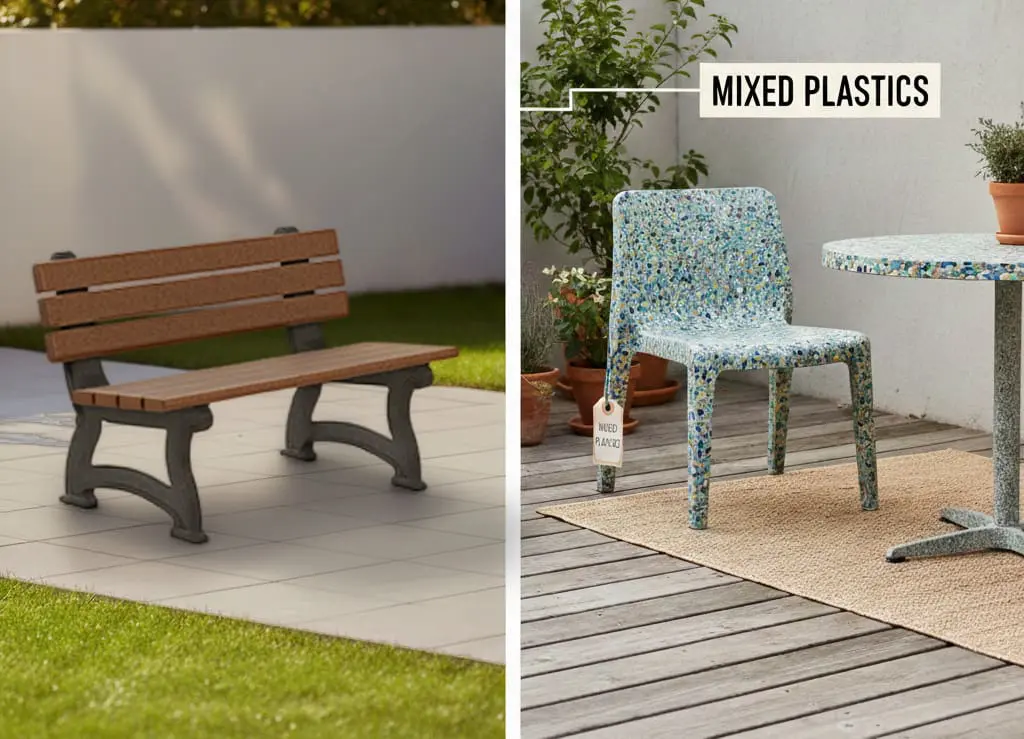
As recycled plastic furniture continues to grow in popularity, customers are seeing a wider variety of materials and manufacturing approaches enter the market. Many manufacturers are working hard to divert plastic waste from landfills — which is a goal we strongly support.
But not all recycled plastic products are made the same way.
One of the most important differences in outdoor furniture construction comes down to material composition:
mono-resin systems (such as 100% recycled HDPE #2) versus mixed plastic blends composed of multiple polymer types.
Understanding how these materials behave over time can help buyers make more informed, long-term decisions.
🧪 What Are Mixed Plastic Products?
Some recycled furniture manufacturers use a blend of plastics — often combining HDPE, LDPE, and polypropylene (PP). These materials are all thermoplastics and can be processed together, allowing manufacturers to divert a broader range of plastics from the waste stream.
This approach can be beneficial from a waste diversion standpoint. However, it also introduces some important material science considerations.
🔬 The Science Behind Mono-Resin vs Mixed Plastics
When a product is made from a single polymer — such as recycled HDPE #2 — the material behaves uniformly throughout its lifespan. Mechanical properties, aging behavior, and weathering characteristics remain consistent across the structure.
In mixed plastic systems, different polymers do not chemically integrate. Instead, they form separate microscopic phases within the material. Over time, these internal interfaces can influence how the product responds to:
- UV exposure
- temperature changes
- repeated loading and fatigue
- long-term environmental stress
This doesn’t mean mixed plastic products are unsafe — but it does mean their long-term performance can be less predictable compared to mono-resin materials.
☀️ Long-Term Durability in Outdoor Environments
Outdoor furniture is exposed to years of:
- sunlight and UV radiation
- freeze/thaw cycles
- daily temperature swings
- repeated use and loading
Mono-resin HDPE typically exhibits a ductile aging behavior, meaning it tends to flex or deform gradually before failure.
In contrast, immiscible polymer blends may develop localized brittle zones over long environmental exposure due to differential aging between polymer types. These differences may influence long-term fatigue performance and crack propagation behavior.
🎨 Appearance Over Time
Material composition can also influence how products age visually.
Mono-resin systems often show:
- consistent color stability
- uniform weathering
- predictable surface texture over time
Mixed polymer systems may experience:
- uneven fading between polymer phases
- localized chalking or gloss variation
- visible flow patterns depending on processing methods
These differences may not be noticeable when products are new but can become more apparent after years of outdoor exposure.
♻️ Recycling and End-of-Life Considerations
All recycled plastic products contribute to waste reduction — but not all follow the same recycling pathways at the end of their service life.
Mono-resin HDPE products can often be:
- reground
- remelted
- returned into similar structural applications
This supports a more circular recycling loop.
Mixed polymer products are still recyclable but typically remain within mixed-plastic applications rather than re-entering single-resin recycling streams. This can limit future reuse options and may result in downcycling into lower-grade materials over time.
🌎 Sustainability Is More Than One Metric
There is no single “right” way to recycle plastic. Some approaches prioritize:
- maximum waste diversion
- broader material acceptance
Others prioritize:
- long service life
- structural predictability
- true closed-loop recycling
Both approaches contribute to sustainability — but they achieve it in different ways.
🧠 Making an Informed Choice
When selecting outdoor furniture, it’s worth considering:
- expected product lifespan
- structural load requirements
- warranty length
- recyclability at end of life
- long-term appearance and maintenance expectations
Understanding the differences in material systems helps ensure that recycled plastic products meet both environmental and performance goals for years to come.
🌿 Our Commitment
We believe sustainability includes not only keeping plastic out of landfills today — but also ensuring that materials remain durable, predictable, and recyclable well into the future.
By focusing on consistent mono-resin recycled HDPE, we aim to deliver products that combine environmental responsibility with long-term performance and true circular material reuse.